 Joint
Injections by
drdoc on-line
The use of corticosteroid injections is a highly effective way to produce symptomatic and therapeutic benefit in the management of arthritis related disease. The use applies in particular to the patient who has inflammed joints out of phase with the rest of the body. It has however - limitations. If there are several swollen joints, the activity of the underlying process must be addressed through proper disease modifying therapy.
Main choice of steroid is triamcinolone hexacetonide or depot medrol.
The joint injection should be a relatively LOW pain procedure. It is a fallacy that joint injections are extremely painful. Large joint injections - especially the knee should not be painful, but small joint injections in the hands may be tender, due to the narrowness of the joint space and also because the hands are designed physiologically to be sensitive to painful stimuli.
However, very rarely an acute flare in inflammation from a response by the body to the crystal structure of the steroid in the injection. This is called a crystal flare. It usually lasts 24-36 hours.
The response to injections are variable, but are especially satisfactory when the joint is inflammed. i.e. warmth and swelling in the joint.My recommendation for large / weight bearing joints ie knee or ankle is to restrict to 2-3 times maximal per year. For non-weight bearing joints i.e. shoulder / elbow / tendon, restriction to 4 per year. Failure of response after repeat injections, should be recognized as such, and ulterior methods used to address the problem
There are other types of joint injection than steroids.This includes Hyaluronan injections, i.e. Synvisc, or Hyalgan.
These are not really in my opinion offering any particular advantage over corticosteroid itself and are extremely costly.
Intraarticular ablative therapy to achieve synovectomy can be attempted by use of Yttrium-90 radioactive injection, or even mustine.
However, these are difficult to use in the office environment and are largely replaced by arthroscopic synovectomy now
Response in osteoarthritis
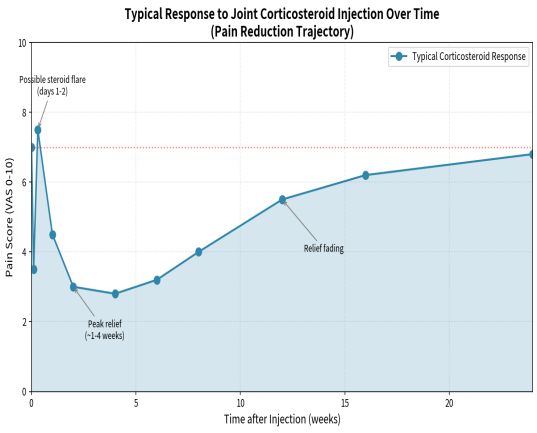
This is a schematic graph of a typical response to a corticosteroid (cortisone) joint injection (the most common type), based on clinical patterns from studies and reviews. It shows average pain score (VAS 0–10) over time for conditions like knee or shoulder osteoarthritis or inflammatory flares.
Key phases of the response
Immediate (hours): If local anesthetic is mixed in, pain often drops quickly, then rebounds as the anesthetic wears off.
Days 1–2: A temporary “steroid flare” (increased pain/soreness) occurs in roughly 1 in 5 patients. This is usually short-lived.
Days 3–7: Steroid anti-inflammatory effect begins; most people who respond start noticing relief (about half within 3 days, over 90% within a week among responders).
Weeks 1–4: Peak relief for many, with pain often dropping substantially (clinically meaningful improvement is common in the first 4–6 weeks).
Weeks 6–12: Benefit gradually fades. Meaningful relief frequently lasts 4–8 weeks (sometimes up to a few months), but by 3–6 months it is often back near baseline.
Beyond 6 months: Little to no lasting benefit over placebo in higher-quality studies for osteoarthritis.
Important caveats
Individual results vary widely depending on the joint, diagnosis (inflammatory vs. mechanical pain), disease severity, injection accuracy, and other factors.
Evidence quality for long-term benefit in osteoarthritis is limited; benefit is mainly short-term.
Repeated injections can have risks (e.g., cartilage effects with frequent use), so they are usually reserved for flares or bridging to other treatment.
Response in rheumatoid arthritis patients
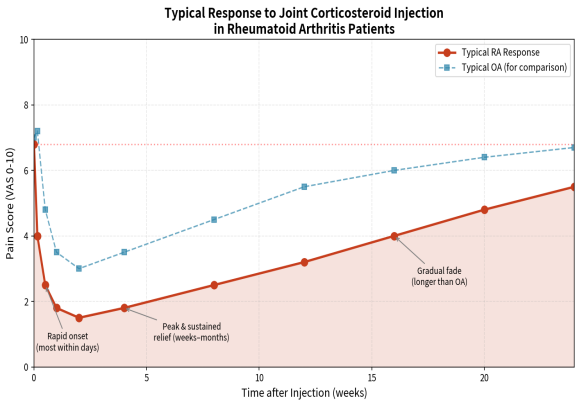
This is a schematic graph of a typical response to intra-articular corticosteroid injection in rheumatoid arthritis (RA) patients, based on clinical studies of joint injections (often triamcinolone hexacetonide or similar long-acting agents). It focuses on pain score (VAS 0–10) over time
Key features of the RA response
Rapid onset: Most patients who respond do so quickly—often within 4 days, with many achieving low pain scores (e.g., NRS ≤2) by 1–2 weeks. About three-quarters of patients show a response in studies of finger joints.
Strong peak effect: Substantial pain reduction (often to low single digits) occurs within the first 1–4 weeks. Inflammatory joints tend to respond more dramatically than purely mechanical OA joints.
Longer duration than OA: Benefit frequently persists for months. Mean time of effect with triamcinolone hexacetonide has been reported around 8 months in RA (vs. shorter in OA). In early RA managed with treat-to-target DMARD strategies, many injected joints show no relapse at 1 year (~62%) and a substantial portion remain improved at 2 years. Among responders in finger-joint studies, ~65% still had low pain at 3 months and ~49% at 6 months.
Gradual fade: Symptoms eventually return as the steroid effect wanes, though the window of useful relief is typically longer than the 4–8 weeks commonly seen in OA.
Important notes
Response is highly variable and depends on joint size/location (small joints like PIP often do better), disease activity, concurrent DMARDs, steroid preparation (less soluble agents last longer), and whether the injection is part of a broader treat-to-target plan.
In RA these injections are usually used for residual active joints while optimizing systemic therapy, not as standalone long-term treatment.
Individual results differ; the curve represents typical patterns among responders, not a guarantee for every patient.